I Want to Start an Online Business — But What Am I Supposed to Sell?
You’ve decided you want to make money online.
Maybe you want extra income before retirement. Maybe you want more freedom, fewer financial worries, or simply something of your own.
You open your laptop, start researching…and suddenly you’re faced with hundreds of possibilities.
Digital products. Affiliate marketing. Coaching. Freelancing. Print-on-demand. Amazon. Courses. Memberships. Ecommerce.
And instead of feeling excited, you end up thinking:
“I want to start an online business, but I have absolutely no idea what to sell.”
If that sounds familiar, you’re not alone.
Choosing what to sell is one of the biggest places beginners get stuck — and unfortunately, many people stay stuck there for months.
The good news?
You do not have to find the perfect product before you start.
You simply need to find a business model that fits your skills, your lifestyle, your budget, and the amount of time you realistically want to spend building it.
Let’s simplify your choices.
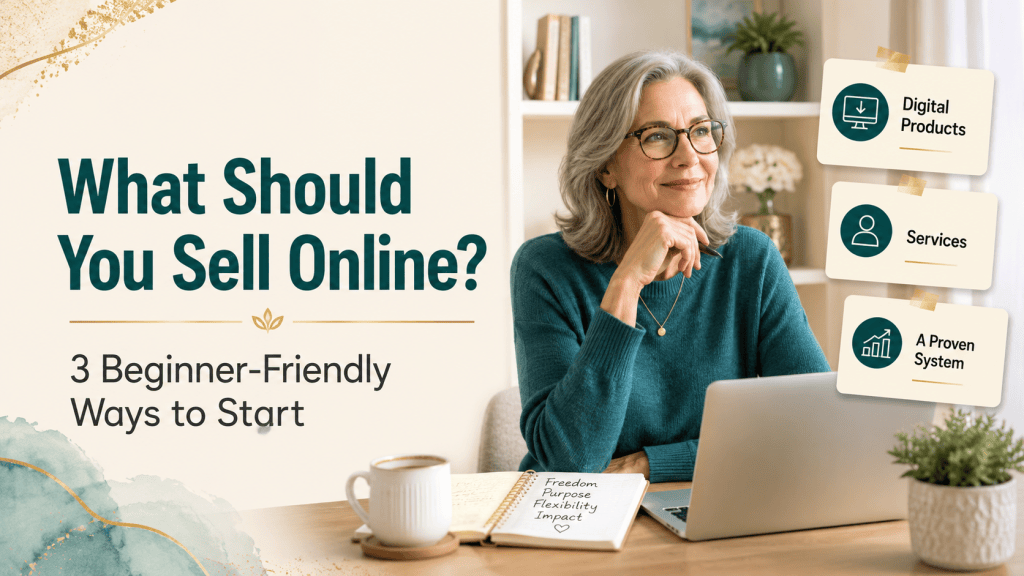
Quick Answer: If you’re not sure what to sell online, start by choosing between three beginner-friendly paths: create a digital product, sell a service based on skills you already have, or use an existing business system with the products and structure already in place. The best choice depends on your time, skills, budget, and goals.
Why Choosing What to Sell Feels So Difficult
When you’re new to online business, almost every idea sounds possible.
That’s part of the problem.
You watch one video and think you should start an Etsy store.
Then someone tells you affiliate marketing is easier.
Then you see someone selling a digital planner they created in Canva.
Five minutes later, someone is telling you to start coaching.
Before you know it, you have 27 tabs open and you’re more confused than when you started.
This is sometimes called analysis paralysis.
You keep researching because you believe that eventually you’ll discover the one perfect business.
But there really isn’t one perfect online business.
There is only the business model that makes the most sense for you right now.
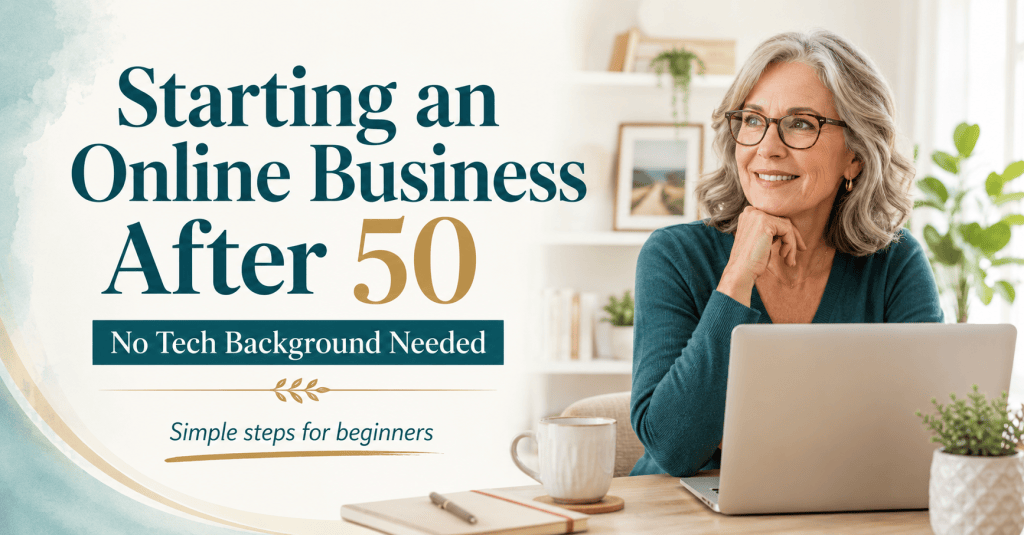
If technology itself is one of the things holding you back, I also wrote a complete beginner guide on Starting an Online Business After 50 With No Tech Background.
The first thing I want you to know is this:
You don’t need to know everything before you begin.
You only need to decide on your first direction.
Start With the Problem — Not the Product
One of the biggest mistakes beginners make is asking:
“What can I sell?”
A much better question is:
“What problem can I help someone solve?”
People rarely buy something simply because a product exists.
They buy because they want an outcome.
Someone buying a meal-planning template may really want to save time.
Someone buying an online business course may want financial independence.
Someone hiring a coach may want accountability and direction.
Someone buying a social media template may want to stop wasting hours creating content.
The product is simply the vehicle that helps them get there.
So before choosing what to sell, think about the transformation.
Ask yourself:
- What problem does this solve?
- Who has this problem?
- Are people actively looking for a solution?
- Would someone pay to solve it?
- Can I realistically help them get the result?
Once you start thinking this way, choosing what to sell becomes much easier.
Option #1: Create Your Own Digital Product
Digital products are one of the most beginner-friendly ways to start selling online.
Unlike physical products, there is generally no inventory to store, nothing to package, and nothing to ship.
You create the product once and can potentially sell it repeatedly.
Examples include:
- Ebooks
- Checklists
- Templates
- Workbooks
- Printables
- Canva templates
- Meal planners
- Budget planners
- Business guides
- Prompt collections
- Mini courses
- Training videos
And today, tools like ChatGPT, Claude and Canva can make the creation process significantly easier for beginners.
For example, you might use AI to help you organize ideas, create an outline, brainstorm product names, write descriptions or improve your marketing copy.
Canva can then help you turn that information into an attractive finished product.
Who is this business model good for?
Creating digital products could be a good fit if you:
- Enjoy creating things
- Have knowledge or experience you can package
- Want a low-overhead business
- Are willing to learn marketing
- Like the idea of creating an asset once and selling it multiple times
The challenge is that creating the product is only half of the business.
You still need people to find it.
That means learning how to create content, build an audience, collect leads or drive traffic.
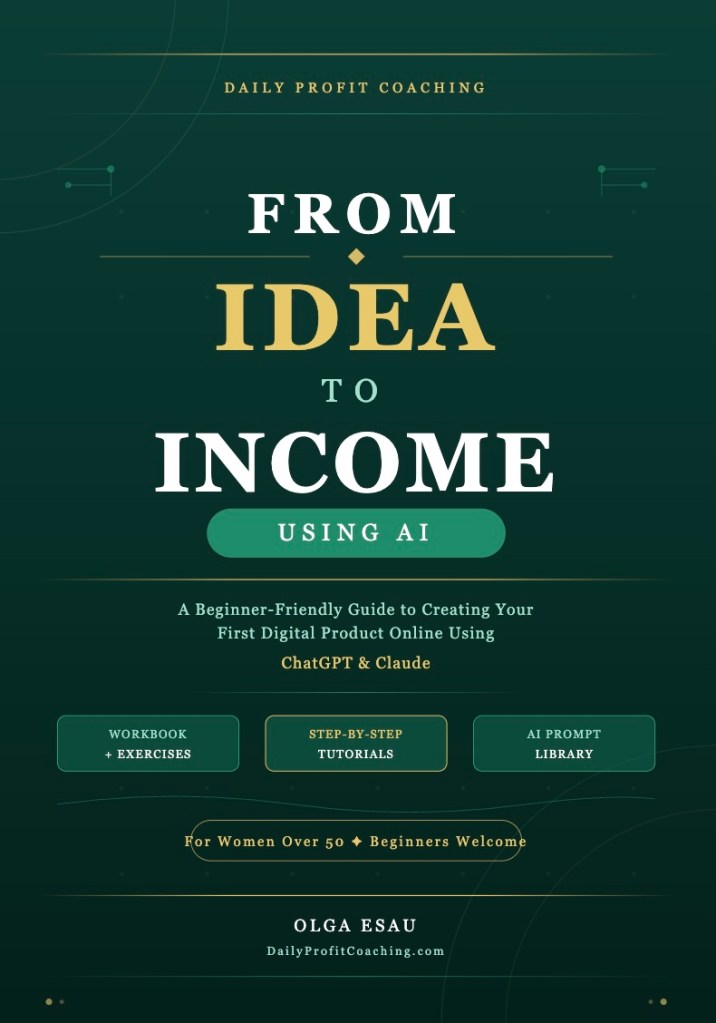
This is exactly why I created my From Idea to Income Using AI beginner guide — to walk someone through turning an idea into a simple digital product using tools such as AI and Canva.
Option #2: Sell a Service or Your Knowledge
You may already have something valuable to sell without realizing it.
Think about everything you’ve learned throughout your career and life.
Maybe you know bookkeeping.
Gardening.
Administration.
Cooking.
Organization.
Marketing.
Photography.
Fitness.
Writing.
Customer service.
Crafting.
Social media.
Business systems.
You don’t necessarily need another certification to help someone with something you already know how to do.
You could offer:
- Freelance services
- Virtual assistance
- Consulting
- Coaching
- Social media management
- Bookkeeping
- Copywriting
- Graphic design
- Tutoring
- Online lessons
Service businesses can often be started very inexpensively because what you’re primarily selling is your skill and your time.
The advantage
You may be able to earn your first income faster because you don’t necessarily need to build a product before selling.
The disadvantage
Your income is usually tied closely to your time.
If you stop working with clients, the income usually stops too.
That doesn’t make services bad.
For many beginners, services are actually an excellent way to generate income while learning how online business works.
Option #3: Start With an Existing Product and System
There is another option that many beginners don’t realize exists.
Instead of creating everything yourself, you can start with a business where the product, training and sales system are already established.
This is the direction that eventually appealed to me.
Why?
Because when I was learning online business, I didn’t want to spend months trying to figure out:
What website do I build?
What funnel do I use?
What emails do I write?
What product do I create?
How do I connect everything?
How do I market it?
I wanted a system I could learn and follow.
That is very different from jumping online and trying to build every moving piece from scratch.
I wrote more about why having a system matters in [The System].
A structured online business can be particularly attractive to someone who wants guidance, training and a clear roadmap rather than figuring everything out alone.
That doesn’t mean there is no work involved.
There is.
You still need to learn.
You still need to market.
You still need to talk to people.
You still need consistency.
But you don’t necessarily have to reinvent every piece of the business.
Which Online Business Model Should You Choose?
Here’s a simple way to think about it.
Choose digital products if…
You love creating things and want to build products of your own.
Choose services if…
You already have a marketable skill and want to start earning by helping clients.
Choose an existing business system if…
You’d rather follow a proven framework than build your products, funnel, website and training from scratch.
There is no right or wrong answer.
The goal isn’t to choose the business everyone else is talking about.
The goal is to choose something you can actually see yourself sticking with.
Ask Yourself These 5 Questions Before You Decide
If you’re still unsure, take a piece of paper and answer these five questions.
1. How much time can I realistically give this?
Not how much time you wish you had.
How much time can you consistently dedicate?
An hour?
Two hours?
Four?
Choose a model that fits your life.
2. Do I want to create a product myself?
Some people love creating.
Others would rather market something that already exists.
Knowing which one you are can eliminate a lot of options immediately.
3. Do I want customers or clients?
There’s a difference.
Clients typically require ongoing personal interaction.
Customers generally purchase a product or program.
Neither is better.
They are simply different business models.
4. How comfortable am I learning technology?
You don’t need to be a technology expert.
But almost every online business involves learning some basic tools.
Email.
Social media.
A website or landing page.
Video.
Payment systems.
AI tools.
Fortunately, most of these are far easier to use today than they were even a few years ago.
And you don’t have to learn everything at once.
5. What do I want this business to do for my life?
This may be the most important question.
Are you trying to make a few hundred dollars a month?
Create a retirement income?
Eventually replace your job?
Build something you can work on while traveling?
Create more time freedom?
Your goal should influence the business you choose.
You Don’t Need Thousands of Followers to Start
This is another myth that keeps beginners from moving forward.
People see creators with 50,000 or 100,000 followers and think:
“How could I ever compete with that?”
But you don’t need everyone.
You need the right people.
Imagine you created something that solved a very specific problem.
You don’t need one million people to buy it.
You need to consistently get your solution in front of people who actually have that problem.
That’s why learning marketing is ultimately more important than chasing followers.
A small audience that trusts you can be far more valuable than a huge audience that barely notices you.
Don’t Spend Six Months Trying to Find the Perfect Idea
This is where I want to save you some time.
You will probably never feel 100% certain before you start.
Most people don’t.
Confidence usually doesn’t come before action.
It comes because of action.
You learn something.
You try it.
You make mistakes.
You adjust.
You get better.
Then something that once felt complicated suddenly feels normal.
That’s how almost every skill works.
Online business is no different.
Starting Later Can Actually Be an Advantage
If you’re starting an online business in your 40s, 50s, 60s or beyond, don’t underestimate what you’re bringing with you.
You have life experience.
Work experience.
People skills.
Problem-solving skills.
Stories.
Relationships.
Knowledge.
Persistence.
Those things matter.
You may not know how to build a funnel today.
You can learn that.
You may not know how to make a Reel.
You can learn that too.
But decades of life experience can’t be downloaded in an afternoon.
That is already yours.
Your First Decision Doesn’t Have to Be Your Forever Decision
This might be the most freeing thing I can tell you.
Your first online business does not have to be your last one.
You can start with one direction and evolve.
Maybe you begin with an existing system and later create your own digital products.
Maybe you start freelancing and eventually turn your knowledge into a course.
Maybe you create a small ebook and discover that people really want coaching from you.
Businesses evolve.
Mine has too.
The important thing is getting into motion.
Because once you’re moving, you have real information to work with.
Until then, everything is hypothetical.
What to Sell Online When You’re a Beginner
If you came to this article hoping I would give you one magic product, I hope you leave with something more useful.
Don’t ask:
“What’s the hottest thing I can sell online?”
Ask:
“Which business model fits the life I’m trying to create?”
Then choose a direction.
Learn the basics.
Follow a system.
Give yourself enough time to get good at it.
And most importantly…
Start.
You don’t need all 20 steps figured out today.
You only need your next one.
Want a Beginner-Friendly Place to Start?
If you’re interested in building income online but you’re still unsure where to begin, I created Daily Profit Coaching specifically to help beginners simplify the process.
Inside, you’ll find training, guidance and a community designed to help you understand your options and move forward one step at a time.
You don’t need to be tech savvy.
You don’t need a huge social media following.
And you don’t need to figure everything out alone.
Start here and see how the system works
Income and business results vary. Building an online business requires learning, consistent effort and marketing. No specific income is guaranteed.